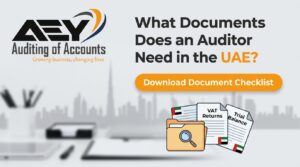
What Documents Does an Auditor Need in the UAE?
One of the simplest ways to make a company audit more efficient is to prepare the right documents before the auditor starts. Incomplete records can lead to repeated questions, delayed testing and extra time spent finding supporting evidence.
The exact document list depends on the company, industry, accounting system and audit scope. A small service business will not always need the same supporting information as a trading company, manufacturer or group with several entities. The list below explains the records that auditors commonly need so business owners and finance teams know what to prepare.

Why Do Auditors Need Supporting Documents?
An auditor does not rely only on the numbers shown in the financial statements. The auditor needs appropriate evidence to understand and assess the information within the agreed scope.
Supporting records help connect the financial statements to the underlying transactions and balances. They can also help explain unusual movements, reconciliations, significant balances and management estimates.
Core Accounting Records
Trial Balance
The trial balance provides a summary of account balances and is an important starting point for understanding the company’s accounting records.
General Ledger
The general ledger provides transaction-level detail behind the accounts. Auditors may use it to select transactions, investigate movements and understand how balances were recorded.
Financial Statements
The draft financial statements and related schedules help the auditor understand the financial position and performance being reported.
Chart of Accounts
Where relevant, the chart of accounts can help explain how the company classifies revenue, expenses, assets, liabilities and other balances.
Bank and Cash Records
Bank statements are commonly requested for the relevant period. The auditor may also need bank reconciliations and supporting information for outstanding or unusual items.
Businesses should make sure all significant bank accounts are included and that reconciling items are explained. Unidentified transactions are a common source of follow-up questions.
Sales and Revenue Records
Auditors may request sales invoices, credit notes, revenue schedules, customer balances and other records that support reported income.
Where the business has contracts or different revenue streams, the auditor may also need relevant agreements or schedules to understand significant transactions.
Purchases and Expense Records
Supporting purchase invoices and expense documentation can help establish what a transaction relates to and how it has been recorded.
Businesses should organize material or unusual expenses and make sure the supporting documentation is easy to trace back to the accounting records.
Accounts Receivable and Accounts Payable
Customer and supplier balances may need schedules showing outstanding amounts, ageing and supporting transaction details.
Old balances often require additional explanation, so businesses should review receivables and payables before the audit starts.
Inventory Records
For companies that hold inventory, auditors may need inventory listings, stock records, valuation information and supporting documentation relevant to the engagement.
The exact procedures depend on the audit scope, but differences between accounting records and physical stock can create additional questions.
Fixed Asset Records
Companies with significant fixed assets may need to provide a fixed asset register, purchase invoices, disposal details and depreciation schedules.
The purpose is to help support the existence, movement and accounting treatment of relevant assets.
Additional Essential Audit Records
Payroll and Employee Records
Depending on the scope, payroll summaries, salary records, employee-related liabilities and supporting schedules may be requested. The finance team should make sure payroll totals can be reconciled to the accounting records.
Payroll and Employee Records
Depending on the scope, payroll summaries, salary records, employee-related liabilities and supporting schedules may be requested. The finance team should make sure payroll totals can be reconciled to the accounting records.
Loans, Financing and Liabilities
Loan agreements, bank financing statements, repayment schedules and related records can help support reported liabilities and financing balances. Material provisions, commitments and other significant obligations may also require supporting documentation.
Related-Party Transactions and Significant Agreements
Where the company has related-party transactions, management should prepare schedules and supporting documentation that explain the nature and value of those transactions. Important contracts, major agreements or unusual transactions may also need to be available for review.
What Happens If Documents Are Missing?
Missing documents do not automatically mean that an audit cannot proceed, but they can create additional questions and delay the work. The auditor may need alternative evidence, explanations or additional procedures. If a document is genuinely unavailable, tell the auditor early rather than waiting until the issue appears during testing.
How to Prepare Your Documents Before an Audit
A practical preparation process is to organize records by account or business area, reconcile key balances, identify unusual transactions and create a clear folder structure for supporting documents.
Use a simple checklist before sending records to the auditor. This can help management identify missing information and reduce unnecessary back-and-forth.
Our UAE Company Audit Checklist can be used as a practical preparation guide.
Final Takeaway
financial statements, trial balance, general ledger, bank records, invoices, customer and supplier schedules, fixed asset information and other supporting evidence.
Preparing these records early can make the engagement more organized and efficient. For an overview of professional audit support, visit Audit Services in Dubai.
If your company requires an external financial statement audit, learn more about External Audit Services in Dubai.
Publishing Notes
Cannibalization control: Keep this article focused on its primary keyword and user intent. Do not optimize it for the broad pillar keyword “audit services dubai”.
Internal linking rule: Use only the contextual links shown in the table above. Avoid adding large blocks of repetitive audit links.
Content rule: Keep the article practical, UAE-specific and business-owner friendly. Update regulatory references whenever official requirements change.